
11 reasons to use the All I See Are Dead Ends workbook

Updated: 5 hours ago
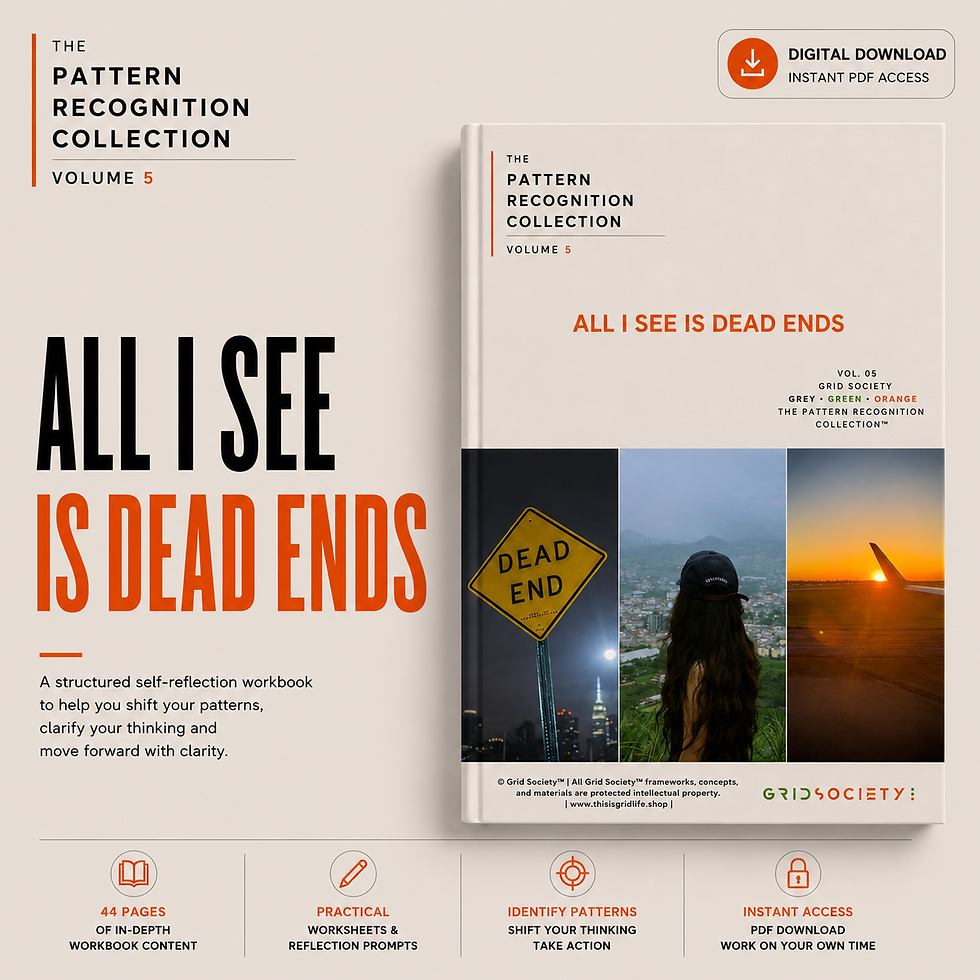
If nothing seems to be working out, repeated setbacks have left you expecting more disappointment or you are struggling to see beyond your current circumstances, this pattern recognition workbook helps you recognise dead-end thinking, explore limited beliefs and start making room for hope, possibility and a bigger vision for your life.
Here are 11 practical ways to use the All I See Are Dead Ends workbook as part of your inner work.
1. Give yourself a Saturday morning check-in
On those Saturday mornings when you tell yourself, “I'm going to make some time for my mind today,” actually make a morning of it.
Go to a café. Order your coffee, macchiato or Frappuccino, find a comfortable spot and open the workbook.
Give yourself 30 minutes and work through the Pattern Recognition Matrix. Look at the dead-end patterns that showed up during the week. Did you dismiss an idea too quickly? Predict the worst after a setback? Compare your progress to somebody else's? Assume an opportunity would not work before exploring i

Notice where you caught yourself, where you considered another route and where your thinking might already be changing. Just you, your drink, your workbook and some proper time with your own thoughts. A productive Saturday morning spent looking beyond the dead ends.
2. Make it part of your Sunday new-week reset
Sunday is a good time to notice what you are about to carry into another week.
Maybe something did not work out. You received another rejection. A plan fell through. You are still waiting for something to change and you can already feel yourself thinking, Here we go again.
Choose one area of your life that currently feels like a dead end. Use the workbook prompts to look at the disappointments or setbacks that may have strengthened that belief and how they are affecting what you expect to happen next.
Use your Sunday reset to separate what has happened from what you have decided will always happen. Start the new week without automatically expecting it to look exactly like the last one.

3. Start your evening reflection with a vision check
Some evenings, you already think you know what tomorrow looks like. Same problems, same routine and the same things you are still trying to change. After enough disappointment, you can start expecting more of the same before tomorrow has even begun.
Dinner is done. Get comfortable on the sofa, pour yourself a glass of wine or make your favourite evening drink and give yourself 15 minutes. Open All I See Are Dead Ends, choose a pattern and let yourself think beyond what happened today. What do you want next? What could change? What would you like your life to look like from here?

Let the evening separate what happened today from what you expect tomorrow. You are not pretending everything will change. You are simply making room for a different possibility before deciding tomorrow will look like yesterday.
4. Reach for it during a 4 a.m. spiral
Things may have finally started looking up. You have been feeling more positive, looking forward to things again and beginning to believe that life really can change.
Then one setback, disappointment, rejection or difficult conversation happens and suddenly, at 4 a.m., your old Grey Voice returns.
“What’s the point?” “See... I told you.” “Nothing has really changed.”
Use the workbook to recognise when one difficult moment is pulling you back onto the same thinking Roundabout. Remind yourself of what has been going well, what has changed and the evidence that life has not been all dead ends.

One setback does not get to predict what happens next. Find the nearest exit.
5. Focus on the Orange when you start to feel anxious
At Grid Society, we have a saying: Orange Tales Only. It means being intentional about the story you tell yourself, but we take it a little further. Visualise orange tales and tell yourself orange tales.
When another disappointment makes everything look bleak, go back through the workbook and focus on the Orange sections. Use them to remind yourself that one closed door does not mean there are no other routes. Allow yourself to imagine alternatives, new opportunities and a future that looks different from what you can see right now.
Life can still bring setbacks. Disappointment can still hurt. The difference is that you no longer allow one difficult moment to convince you that everything leads to a dead end.

6. Track the changes that are difficult to see
The beauty of this workbook is that it makes it easy to track changes that are not always obvious.
Use the Pattern Recognition Matrix to come back to a particular pattern from day to day, week to week or even months later and see how you feel about it now.
You can see whether you are dismissing fewer possibilities, recovering from setbacks differently and becoming more open to what could happen next.
It gives you a visual record of changes you might not have noticed otherwise.

7. See what the pattern can look like at different life stages
The Life on the Grid section gives you a chance to read about the problem using our metaphor. Step outside of your feelings for a moment and focus on the dead-end thinking itself.
1. What life looks like when all you can see are dead ends
2. What it can look like during a 4 a.m. spiral
3. What it looks like when hope starts returning
4. What life can look like when you can see possibilities again
Sometimes removing yourself from the centre of the problem makes it easier to recognise how far your thinking has travelled and where you are trying to get to.
8. Ask yourself different questions.
If you keep asking yourself “Why does nothing ever work out for me? What’s the point?” you can end up going round in circles and finding more evidence that life is full of dead ends.
The prompts inside the All I See Are Dead Ends workbook give you different questions to ask yourself about the problem, helping you look at your situation from angles you may not have considered before.
You might recognise a disappointment that became a belief. An opportunity you stopped exploring. A setback you turned into a prediction about your future. Sometimes a different question is all it takes to start seeing something you could not see before.

9. Give your journalling a new lease of life
If you are tired of traditional journalling, or you want to journal but never know what to write, use the Grid Society concepts to get creative with it. Bring in our Grid Life colours, places, moods and emotions. Create your own affirmations, new sayings and personal reminders inspired by the Grid Society concepts.
Instead of silently telling yourself, “All I see are dead ends,” writing another diary entry or simply offloading how you feel, use your journalling to start imagining what else could be possible.
Create a new narrative: “There is more ahead for me than I can see right now.” What would you start looking forward to? What would you try again? What could your life look like if you allowed yourself to expect good things again?
Let your journalling become a place where you practise seeing beyond your current circumstances. Give yourself room to expect, explore and imagine again.

10. Use it as a starting point before seeking professional support
Sometimes feeling as though you have reached a dead end can make you realise there may be something deeper you would like to explore. Perhaps the same beliefs keep appearing around your future, your relationships, your work or what you believe is possible for you.
Use the workbook to start identifying the thoughts, behaviours, situations and patterns that keep coming up for you. It can help you put some of what you have been experiencing into words, so if you decide to speak to a counsellor, therapist or another appropriate professional, you already have somewhere to start the conversation.
11. Use the workbook concepts in real life
Use the whole workbook as an inspiration platform and take the Grid concepts into your everyday thinking.
1. Stay off the Grey Grid
Be conscious of the beliefs that make everything look like a dead end.
2. Find the nearest exit
When disappointment starts convincing you that nothing will change, find your exit.
3. Make Gridmoves
Recognise when you are seeing possibilities, trying something different or moving forward.
4. Orange tales only
Keep visualising new routes, new opportunities and a future beyond what you can see right now.
These are more than concepts. They are real-life anchors you can carry into your everyday life.

At work, at home, making a decision or facing another setback, they give you something familiar to come back to and remind you that one dead end does not mean there are no other routes.
The Pattern Recognition
Collection™
by Grid Society
See your patterns.
Name your patterns.
Change your patterns.
Copyright
The Grid Society concept and Universal Grid™ were created by E. Lee and Dr N. Michelle to provide a structured framework and original lexicon for understanding thinking patterns and behaviours, and acting on them positively in real time. The Universal Grid™ incorporates the Grey Grid™, the Green Grid™ and the Orange Grid™, together with all associated frameworks, principles, concepts, terminology and methodologies. All original content and supporting materials are the intellectual property of Grid Society. All rights reserved.
Disclaimer
Grid Society content is created for personal development, self-reflection and educational purposes. It is not intended to replace professional medical, mental health, legal or financial advice. We are affiliated with qualified mental health professionals who can provide professional support where needed.
Pattern Recognition Self-Reflection Workbooks™ Volumes 1–7 | Live Online Workshops and Masterclasses | In-Person Workshops for Organisations in the UK and UAE | CPD Workshops for Counsellors and Organisations | 30-Day Personal Development Challenges | 4 A.M. Motivation Articles that we call THISISGRIDLIFE.
Grid Society Workbooks
Comparison - People-Pleasing and Boundaries - Ghosting and Texting - Inner Critic - Limited Beliefs - Breaking Cycles - Empty Success - Comparing Yourself to Friends - Setting Boundaries - Texting Anxiety - Putting Yourself Down - Repeating the Same Mistakes - Feeling Empty After Success - Red Flags in Relationships


Comments