
Live it. Find The Nearest Exit: Recognising when something is no longer working and choosing a new way forward

Updated: 2 days ago
The Grid Society philosophy behind "Find The Nearest Exit"

At Grid Society, we help people develop greater self-awareness, recognise behavioural patterns and make more intentional choices about how they think, feel and live through our personal development workshops, workbooks and learning experiences.
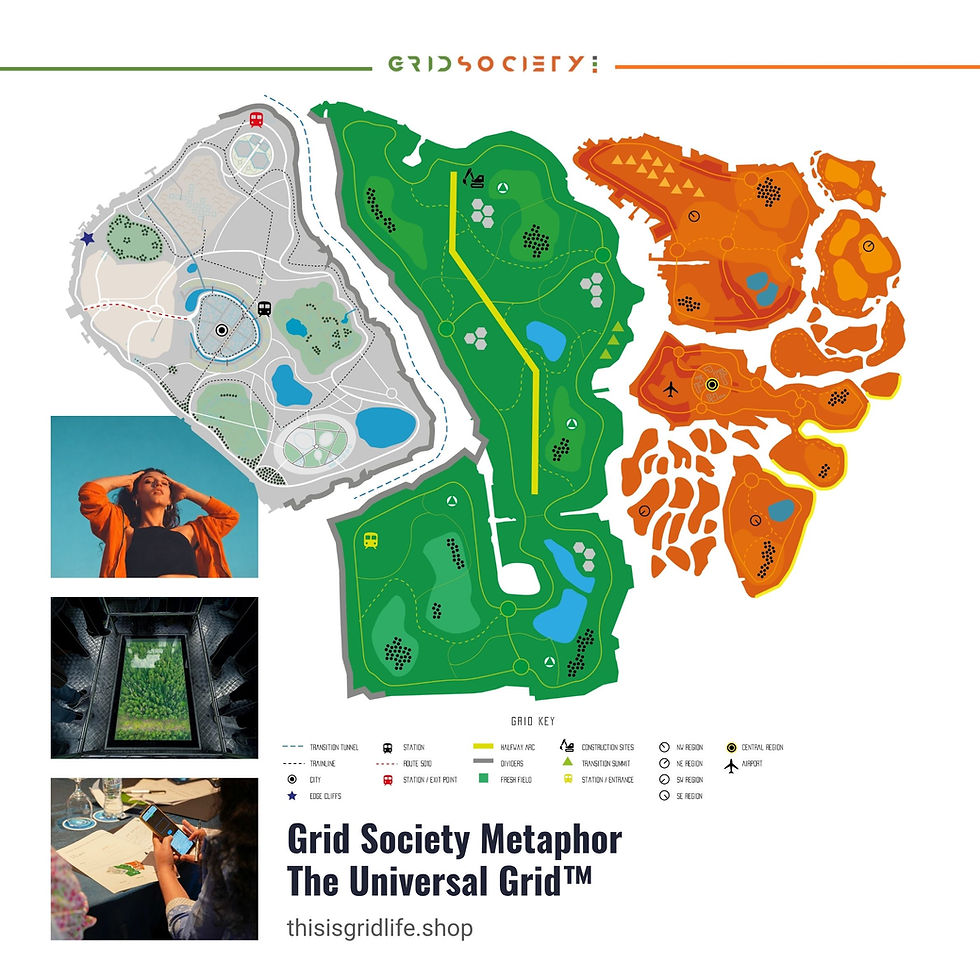
At the heart of our philosophy is the Universal Grid™, a metaphorical world built around three states of mind:
This fictional world allows people to step outside their everyday experiences, observe their thoughts and behaviours from a different perspective and navigate real-life situations with greater awareness.
To complement the Universal Grid™, we created the Grid Society Lexicon™, a dictionary of original phrases and terminology that gives people a distinctive vocabulary to describe their thoughts, emotions and behaviours as they move across the Grid.

Much to our delight, this vocabulary has become a shared language, used by Grid Society readers and workshop attendees to name emotions, pinpoint where they are in life and speak with precision about the changes they are experiencing and making.
We do not use these terms casually. They give shape to what is often invisible and help people explain the hard-to-explain. We use them to locate ourselves, name patterns and push back against the things that keep us stuck.
Find the Nearest Exit™ – definition
Find the Nearest Exit™ is a Grid Society phrase that encourages you to recognise when a thought pattern, behaviour or situation is no longer serving you and identify your next available way forward.
Within the Universal Grid™, finding the nearest exit can mean exiting the Grey Grid™, leaving it behind you and not looking back.
It can also mean exiting the Grey Grid Roundabout™, where overthinking, second-guessing, going around in circles and repeating the same mistakes can keep you stuck.
Finding the nearest exit does not mean having every answer or changing your entire life overnight.
Sometimes, your exit is a different decision, a new perspective or one small Gridmove™ that takes you in a better direction.

3 things to know about the Find the Nearest Exit™ philosophy
You need to recognise when it's time to find an exit
Sometimes you already know something isn't working. You recognise the familiar feelings, the repeated mistakes or the situations that keep taking you back to the Grey Grid™. Yet you continue, hoping that something will change.
Finding your nearest exit begins with being honest about where you are. You cannot choose a different direction while continuing to convince yourself that the road you're on is taking you somewhere you want to go.
Recognising that you need an exit is the beginning of finding one.

Your nearest exit may be closer than you think
When you're overwhelmed by a situation, it can feel as though you need to change everything to make progress. You imagine enormous decisions, difficult conversations or a completely different life.
Yet your nearest exit might be a boundary you establish, a conversation you stop replaying, a habit you decide to change or one small Gridmove you make today.
You don't always need a complete plan to begin moving in a different direction.
Sometimes, the smallest decision creates the opening you've been looking for.
Finding an exit means choosing to take it
Recognising an exit and taking it are two different things. You can know exactly what needs to change and still find yourself returning to familiar behaviours, relationships or decisions.
The Find the Nearest Exit™ philosophy encourages you to move beyond recognition. It asks you to consider what you're prepared to do differently, even when the familiar route feels easier.
An exit is an opportunity, but your choices determine whether you take it.
You can recognise the exit, but you still have to make the decision to take it.

3 ways to find your nearest exit using Grid Society Pattern Recognition Workbooks
1. Exit the cycle of making the same mistakes
Pattern Recognition Workbook: I Keep on Making the Same Mistakes
Sometimes your nearest exit is recognising a familiar pattern before you repeat it. This workbook helps you examine the behaviours and decisions that keep bringing you back to the same situations, even when you promised yourself things would be different.
Use the pattern recognition matrix to identify where you keep going wrong and explore the choices that could help you break the cycle.

2. Exit the belief that every road leads to a dead end
Pattern Recognition Workbook: All I See Is Dead Ends
When limiting beliefs influence how you see your future, even genuine opportunities can begin to look impossible. You may convince yourself that you've tried everything, nothing will work or there is nowhere left to go.
This workbook encourages you to recognise the thinking patterns that restrict your possibilities and consider opportunities you may have been overlooking.

Your nearest exit might be a possibility you have already convinced yourself does not exist.
3. Exit the habit of putting everyone else's needs before your own
Pattern Recognition Workbook: People-Pleasing and Boundaries
Sometimes your Grey Grid™is built around seeking approval, avoiding difficult conversations, ignoring red flags and repeatedly compromising your own needs to keep other people happy.
This workbook helps you recognise people-pleasing patterns, examine the boundaries you struggle to maintain and understand how your own behaviours and decisions can keep you returning to situations that leave you unhappy or frustrated.

Your nearest exit might begin with recognising a familiar pattern and deciding that this time, you will do something differently.
Copyright
The Grid Society concept and Universal Grid™ were created by E. Lee and Dr N. Michelle to provide a structured framework and original lexicon for understanding thinking patterns and behaviours, and acting on them positively in real time. The Universal Grid™ incorporates the Grey Grid™, the Green Grid™ and the Orange Grid™, together with all associated frameworks, principles, concepts, terminology and methodologies. All original content and supporting materials are the intellectual property of Grid Society. All rights reserved.
Disclaimer
Grid Society content is created for personal development, self-reflection and educational purposes. It is not intended to replace professional medical, mental health, legal or financial advice. We are affiliated with qualified mental health professionals who can provide professional support where needed.
Pattern Recognition Self-Reflection Workbooks™ Volumes 1–7 | Live Online Workshops and Masterclasses | In-Person Workshops for Organisations in the UK and UAE | CPD Workshops for Counsellors and Organisations | 30-Day Personal Development Challenges | 4 A.M. Motivation Articles that we call THISISGRIDLIFE.
Grid Society Workbooks
Comparison - People-Pleasing and Boundaries - Ghosting and Texting - Inner Critic - Limited Beliefs - Breaking Cycles - Empty Success - Comparing Yourself to Friends - Setting Boundaries - Texting Anxiety - Putting Yourself Down - Repeating the Same Mistakes - Feeling Empty After Success - Red Flags in Relationships
Grid Society Workshops & Masterclasses
Morning Reset Instant Access - Confront the Grey Voices Live Workshop - Building Boundaries Live Workshop - Vision Quest Live Workshop - Silencing the Inner Critic CPD Workshop - Dating Codes Instant Access Workshop


Comments