
Don’t you dare let comparison steal your joy in the morning: years of comparative thinking can affect your self-perception

Updated: Sep 27

So many people live with comparative thinking for years, sometimes decades, until they stop seeing it as a pattern of thinking and start seeing it as part of their personality.
“That is just how I am.”
“I have always compared myself to other people.”
“That is just how my brain is wired.”
Some people even personify it, turning comparison into a fixed character trait rather than questioning whether it is a repeated thought pattern they have practised for years.
The danger is that once you believe something is simply who you are, you are far less likely to challenge it. You can spend years living in a mental contest with other people’s money, relationships, appearance, careers and achievements without ever asking what that constant comparison is doing to your self-perception.
At Grid Society, we see the effects of comparative thinking time and time again in our Confront the Grey Voices™ workshop. It is one of the reasons comparison became the focus of Volume 1 of our Pattern Recognition Workbook Collection, I Feel Like I’m Behind Compared to My Friends.

In this post, we have decided to fast-forward. We are not looking at the uncomfortable feeling comparison gives you this morning. We are looking further down the road at what years of comparative thinking can do to your self-perception, your decisions, your definition of success and ultimately, the way you see yourself.
4 signs that reveal the hidden cost of years of comparative thinking
#1 - CAUTION
You become an empty vessel, incapable of feeling successful because nothing you achieve gives you any lasting sense of fulfilment.

Comparative thinking signs
You achieve something and feel almost nothing because your mind immediately finds someone who has achieved more.
Compliments stop landing because praise from other people cannot compete with the inadequacy you have built internally.
You constantly need another achievement because the satisfaction from the last one disappears almost immediately.
You cannot properly celebrate yourself because even your proudest moments come with an internal “yes, but…”
#2 - BEWARE
You become emotionally controlled by other people’s lives, allowing their promotions, relationships, money, appearance and milestones to determine whether you feel good or terrible about your own.

Comparative thinking signs
One social media post can ruin a perfectly good morning because somebody else's announcement instantly changes how you feel about your own position.
You start dreading certain people's good news because their success has become emotionally painful for you.
Your confidence rises and falls according to who is in the room because you feel successful around some people and completely inadequate around others.
You compulsively check what particular people are doing even though you already know that seeing their lives often leaves you feeling worse.
#3 - TAKE HEED
You can spend years chasing a version of success you never genuinely wanted, only to realise that comparison has been making major life decisions on your behalf.

Comparative thinking signs
You pursue goals because they look impressive rather than because they matter to you, then wonder why achieving them feels strangely hollow.
You rush major milestones such as relationships, marriage, children, property or career progression because everybody else appears to be getting there first.
You abandon things you genuinely enjoy because they do not look successful enough when placed beside somebody else's life.
You keep changing the destination because every new person you compare yourself with gives you another idea of what your life is supposedly missing.
#4 - BE CAREFUL
You can lose so much confidence in your own timing and judgement that, eventually, you stop knowing what you want, stop trusting your own decisions, and lose your sense of who you are without everybody else as the reference point.

Comparative thinking signs
You struggle to make decisions without checking what everybody else thinks first because your own judgement no longer feels trustworthy.
You cannot tell whether you genuinely want something or simply think you should want it because comparison has blurred the distinction.
You second-guess decisions that once felt right the moment you see somebody else choosing differently.
You stop knowing what success looks like for you because you have spent so long borrowing your definition from everybody else.
Do not let comparative thinking become your normal
It is our hope at Grid Society that this post helps you recognise any comparative thinking you may have made a habit and encourages you to question where that thinking could lead if you continue to give it space in your life. Recognise the pattern now, rather than living with its effects for years.
Explore the Pattern Recognition Collection
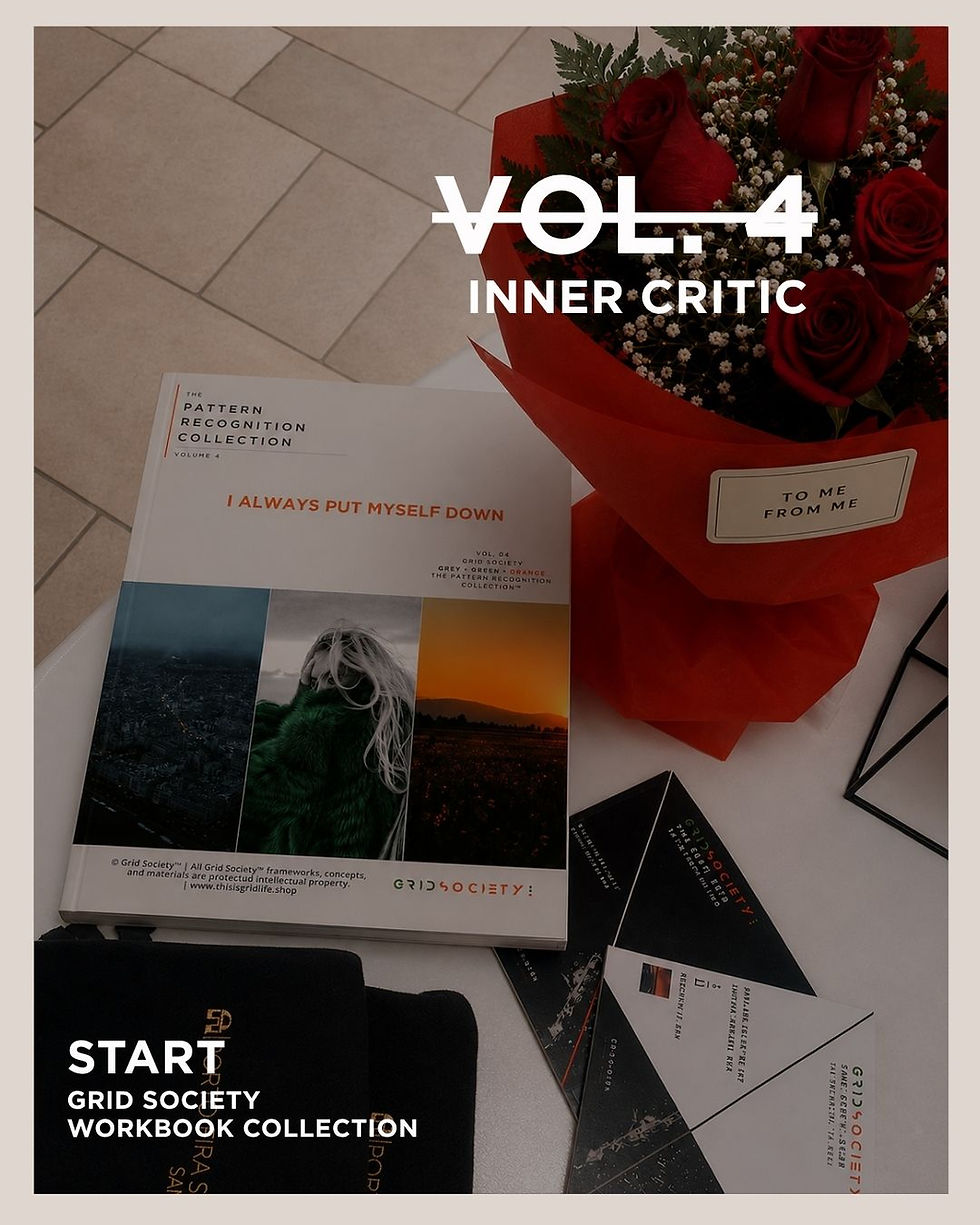
The Pattern Recognition Collection™ is a growing collection of practical self-reflection workbooks designed to help you recognise recurring patterns in the way you think, respond and behave.
Each workbook focuses on a specific real-life problem, from comparison and people-pleasing to overanalysing messages and negative self-talk, giving you space to identify the patterns that may be keeping that problem active.
Designed for real life, the collection can go wherever you do.
Open a workbook on your phone or iPad, take it to a café, use it while travelling, reach for it during a 4 a.m. thought spiral or sit down with it when you have more time to reflect. Use it for a quick check-in or spend longer working through your thoughts with pen and paper.

Start with the problem you recognise. Then discover the patterns underneath it.
The Pattern Recognition
Collection™
by Grid Society
See your patterns.
Name your patterns.
Change your patterns.
Copyright
The Grid Society concept and Universal Grid™ were created by E. Lee and Dr N. Michelle to provide a structured framework and original lexicon for understanding thinking patterns and behaviours, and acting on them positively in real time. The Universal Grid™ incorporates the Grey Grid™, the Green Grid™ and the Orange Grid™, together with all associated frameworks, principles, concepts, terminology and methodologies. All original content and supporting materials are the intellectual property of Grid Society. All rights reserved.
Disclaimer
Grid Society content is created for personal development, self-reflection and educational purposes. It is not intended to replace professional medical, mental health, legal or financial advice. We are affiliated with qualified mental health professionals who can provide professional support where needed.
Pattern Recognition Self-Reflection Workbooks™ Volumes 1–7 | Live Online Workshops and Masterclasses | In-Person Workshops for Organisations in the UK and UAE | CPD Workshops for Counsellors and Organisations | 30-Day Personal Development Challenges | 4 A.M. Motivation Articles that we call THISISGRIDLIFE.
Grid Society Workbooks
Comparison - People-Pleasing and Boundaries - Ghosting and Texting - Inner Critic - Limited Beliefs - Breaking Cycles - Empty Success - Comparing Yourself to Friends - Setting Boundaries - Texting Anxiety - Putting Yourself Down - Repeating the Same Mistakes - Feeling Empty After Success - Red Flags in Relationships


Comments